Understanding Callsheets Part1
This guide breaks down the most common questions people have about call sheets—what the sections mean, how to read them, and how to understand the information that affects your day on set. Each topic is explained in plain language with examples, so you can quickly get comfortable navigating a call sheet. Use the links below to jump directly to any section you want to explore.
Quick Navigation
- What is my call time?
- What does “crew call” mean?
- What is “first team” vs “second team”?
- How do I know what scene we’re shooting?
- Where do I see if I’m in the scene?
- What do all these Abbreviations mean?
- Who do I contact if I’m late or lost?
- Where do I find the walkie channels?
- What does the “advance schedule” mean?
- What are unit numbers?
- What does “company move” mean?
What is my call time?
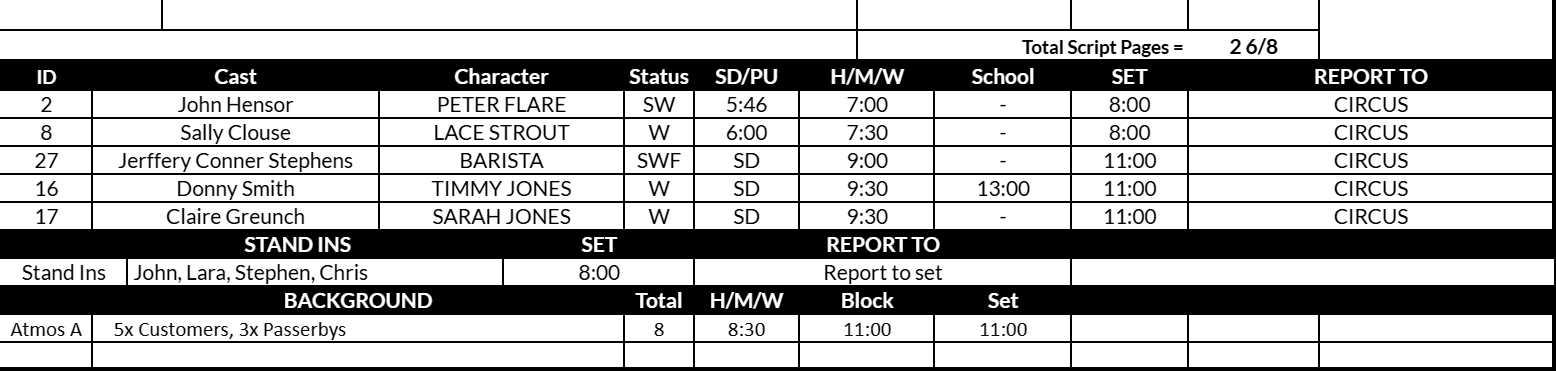
Your call time is the exact time you must arrive and be ready to start your day. It’s personalized because every role has different prep needs. For example:
- Actors need time for hair, makeup, and wardrobe. If you were Sally in the image above you would need to be getting your Hair, Makeup, Wardrobe at 7:30AM.
- Background may need wardrobe approval or fitting
- Camera, lighting, and grip may start earlier to prep equipment
- Some departments only arrive once set is lit or dressed
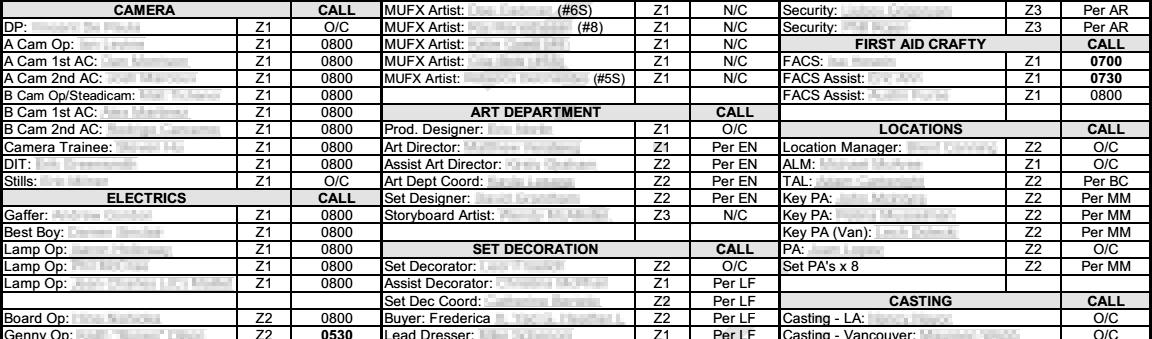
Your call time is always listed next to your name or department — never assume it’s the same as anyone else’s.
What does “crew call” mean?
“Crew call” is the time the main crew officially starts work. This is usually the lighting, camera, grip, electric, and AD teams. It is not your personal call time unless you are part of that group.
Many people start earlier (e.g., hair/makeup) or later (e.g., props arriving after load-in). Crew call is simply the baseline start time for the majority of the crew.
What is “first team” vs “second team”?
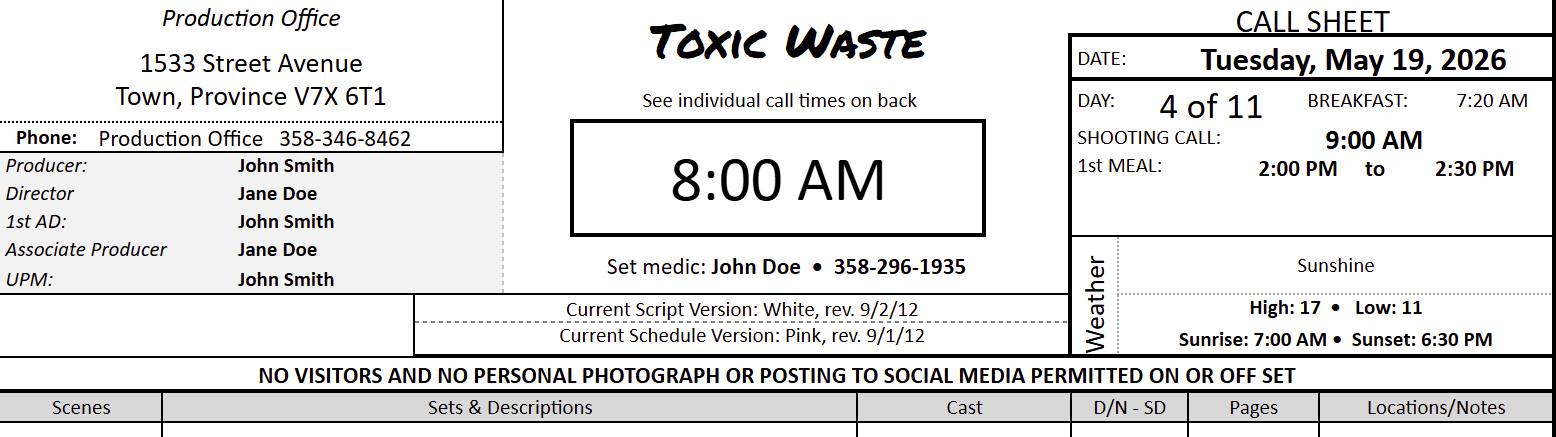
First Team refers to the principal actors who appear on camera.
Second Team refers to stand-ins who match the actors’ height, skin tone, and general silhouette. They take the actors’ place to assist the camera department with:
- Lighting setup
- Camera blocking
- Focus marks
This allows First Team to stay in hair/makeup or holding until the set is ready for them. Stand-Ins are considered to be crew even though they have Background agents that usual get them the gig.
How do I know what scene we’re shooting?
Call sheets list scenes by their scene numbers. You will see a table that usualy has, Scene, Set & Description, D/N, Cast, and Pages. This is where you see a lot of info about a scene. Often productions won't shoot in order of this or will blend two scenes together.
- SCENE: Shows the number of the scene (e.g., 12, 13, 16, 34, 42)
- SET & DESCRIPTION: Will show the set name, wether its Exterior or an Interior scene. Aswell as a little description of the scene.
- D/N: What day/night the speific scene is on in the story
- CAST: Cast will have a number associated with their character, if they are in scene it will appear there. Aswell as things like 'Atmos A' which is background/extra actors.
- Pages: Page count (how much of the script that scene covers)
Where do I see if I’m in the scene?
Each scene lists the cast numbers and background categories required. If your cast number or background category appears, you’re in that scene. If it doesn’t appear, you’re not needed for that specific shot.
What do all these Abbreviations mean?
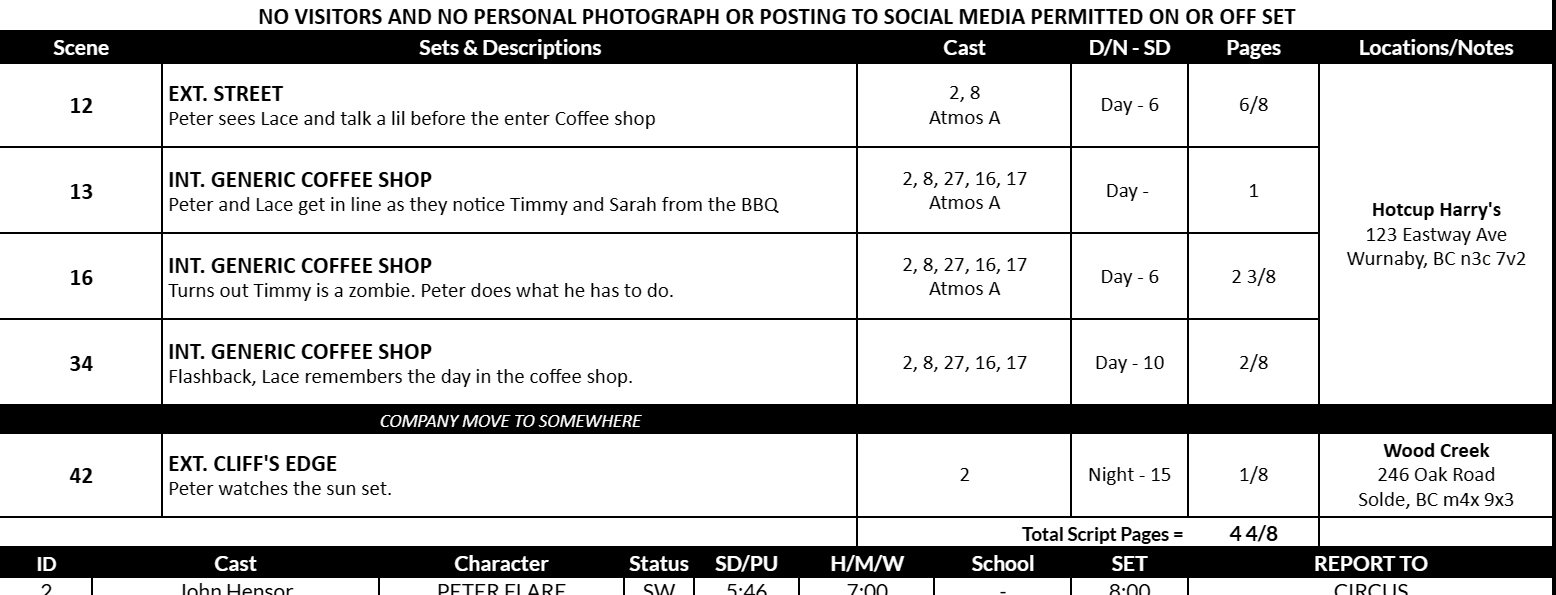
Some of the many abbreviations seen on a Callsheet:
- INT – Interior
- EXT – Exterior
- D12 or N5 – Day 12 or Night 5 (in the script)
- PGS – Pages
- SWF – Start - Work - Finish
- P/U – Pick Up
- HMW – Hair Makeup Wardrobe Call
- BG – Background Actors
- Atmost A – A group of Background Actors
- PM – Production Manager
- AD – Assistant Director (1st 2nd 3rd, on set and offset)
- TAD – Trainee Assistant Director
- HOD – Head of Department
- MUFX – Make Up Effects
- DOP – Director Of Photograph
...and many more
Who do I contact if I’m late or lost?
At the bottom of the first page of a callsheet there are a bunch of important phone numbers usually. The call sheet lists emergency contact numbers for the AD team. If you’re running late or can’t find parking:
- Call the AD or PA listed under “Emergency Contacts”
- Keep the message short and clear
- Calling your HOD letting them know you will be late
- Location Manager or assistant LM if you are super lost.
Being late without notifying anyone can delay the entire production, so communication is critical.
Where do I find the walkie channels?
Walkie channels are usually listed in a small box at the bottom of the 2nd page of a callsheet labeled “Radio Channels” or “Comms.” A typical setup might look like:
- Channel 1 – Main
- Channel 2 – Short Chat
- Channel 3 – Grips
- Channel 4 – LX
- Channel 5 – Long Chat
- Channel 6 – Camera
- Channel 7 – SPFX
- Channel 8 – Shuttles
- Channel 9 – Stunts
- Channel 10 – Locations
This will differ on all productions. They are all similar but can be slightly different.
What does the “advance schedule” mean?
The advance schedule is a preview of what’s planned for tomorrow or the next few days. It is almost always in between the cast and AD phone number secetions. It helps departments prepare:
- Wardrobe pulls
- Props and set dressing
- Gear and lighting setups
- Location prep
It’s not final, but it gives everyone a head start.
What are unit numbers?
1st Unit shoots the main scenes with principal actors.
2nd Unit shoots inserts, stunts, driving shots, or scenes without main cast.
Splinter Unit is a small offshoot team shooting something simple while the main units work elsewhere.
Call sheets will clearly label which unit is shooting which scenes.
What does “company move” mean?
A company move means the entire production relocates to a new location during the same shooting day. This affects:
- Travel time
- Parking and basecamp
- Gear load-out and load-in
- Where holding and HMU are set up
Call sheets will list the move time and the new address so everyone knows where to go next.